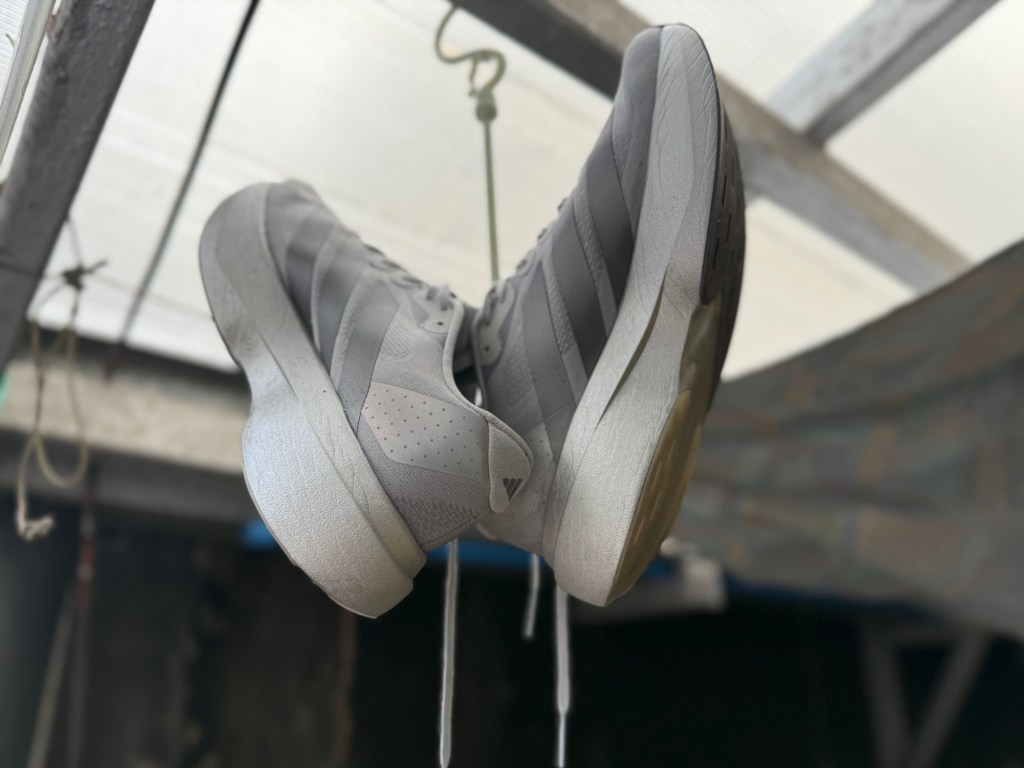
My time for today’s Rexona 10-miler Pasay leg is 1:59:18. That’s a 7:26/km average pace — slower than the 21K I ran last week at 7:16/km, where I actually closed stronger in the second half.
So yes it was shorter, slower, and definitely frustrating.
And what stings more that it felt good at the beginning. I had that sensation where everything seemed to click — light legs, smooth rhythm, easy breathing. I even had to consciously hold myself back in the opening kilometers. “Don’t go out too fast,” I had to remind myself. “Stick to the pace.”
I was settling in at around kilometer 4. I hit the right pace and was feeling strong. But right around kilometer 6, things shifted. It wasn’t anything dramatic. No sharp pain. No sudden loss of breath. Just a steady drain. My legs began to lose that bounce. My rhythm slipped. And mentally, I started fading too.
So hear with are with a post-mortem analysis. What was the probable cause?
I made one big change for this run. I wore the Adidas Adizero Evo SL — a shoe I just recently purchased and I tested on a short tempo run.
Was It the Shoe?
The EVO SL is a lightweight, speed-oriented shoe that uses the same Lightstrike Pro foam found in Adidas’ super shoes, but without a carbon plate. That’s actually why I bought it. I wanted to try something close to a super shoe — something that felt fast and efficient — without jumping all the way into plated territory.
And at first, it felt great. The shoe is light, responsive, and definitely built for quick turnover. So why did it backfire?
After this run, I did much AI-driven research. Now I’m no shoe scientist so maybe my research is wrong. But as of this writing, I’m convinced: I’m not yet ready for this shoe. At least not now. Let me break down the results of my research and how it aligned with my experience:
Not Quite a Super Shoe But Still Has High Demand
Even without a carbon plate, the Evo SL behaves like a stripped-down super shoe. It has an aggressive rocker, a low stack height (26mm at the heel), and a firmer, springier foam. That combination reduces mechanical support and increases neuromuscular demand, meaning your legs, feet, and stabilizers do more work every step.
If your form breaks down, the shoe doesn’t cover for you. It exposes you.
Minimal Cushion, Max Exposure
Compared to something like the Boston 12, the Evo SL offers less shock absorption. It’s designed for efficiency, not comfort. And that’s great when your mechanics are clean and you’re running fast. But in a longer effort like today’s 16K, that lack of cushion led to early localized fatigue, especially in the calves, hips, and small stabilizers.
Walk-Break Clue: Recovery, Then Collapse
One of the clearest signs was obvious. After I took walk breaks, I briefly returned to decent form. This return lasted only for about 3 to 4 minutes. Then things fell apart again.
That’s classic neuromuscular fatigue, not aerobic failure. My heart rate felt controlled. In fact, just before the turn from Vicente Sotto to Roxas, another runner pulled up beside me. We chatted for several seconds about our pace, our struggles, the weather, and how we were both dreading the upcoming Buendia flyover.
The fact that I carried a short conversation tells me I was around upper Zone 2 or low Zone 3, well within a manageable aerobic range. So this wasn’t about cardio. It was about peripheral fatigue — my legs just couldn’t sustain the demand that the shoe was placing on them.
Adaptation Is Earned
Now before many of you chastise me for trying out a new pair during a race, I did test it in a 4k tempo run and it felt great! But lesson learned: just because a shoe feels great in a short, fast run doesn’t mean it’s ready for longer efforts. A 4K test is nothing like a 16K of sustained effort. Apparently, what I lacked was accumulated adaptation — the adaptation that builds slowly through volume and consistency.
I’m convinced that the shoe was the tipping point, but there were other stressors too.
I had mild stomach discomfort. Was it from my usual breakfast of yogurt and oat milk? But it’s worked before. Maybe it’s because I had a different brand of yogurt? But whatever is the cause, I had gas pain (with the corresponding risk of you-know-what) that became a distraction.
Other Factors
Then there was another major factor: the heat index.
Looking at my weather app, it said it had felt like 31°C during the run. The estimated humidity had been around 82%. No wonder I was sweating profusely. I constantly had to stop at water stations to guzzle electrolyte drinks and water and douse myself water. Fortunately, the water stations were abundant, and the drinks were cold.
High humidity compromises your ability to cool through sweat evaporation. Your core temperature rises faster. Your heart works harder to maintain blood flow for both oxygen delivery and cooling. Even if you’re not “overheating” in the classic sense, your perceived exertion goes up, and your muscular efficiency goes down.
In short, in high humidity environments, you feel heavier, slower, and less coordinated.
Add all of that that to a shoe that doesn’t provide cushion or stability, and it’s a recipe for faster fatigue — especially when trying to hold a steady pace.
What I’m Taking Away
The EVO SL is a good shoe. But it has a high demand. It’s light, fast, and efficient, but it offers little room for error. If you’re not biomechanically efficient or you lack the leg strength, it could drain you.
So for the upcoming 21K on May 24, I’m going back to the Boston 12s. Not because they’re magic, but because they’re familiar, forgiving, and supportive.
The Evo SL? Maybe I’ll save that for later. When I’ve trained for it.
 Mon Solo's Running Site