
Many runners rely on their gadgets to determine training zones. Worse, they stick with whatever their watch spits out, which is often based on the outdated and wildly inaccurate formula of Max HR = 220 – age. Because the formula is relying on statistical averages, it’s imprecise and worthless for individualized training; it can send your training off-course, especially if you’re chasing a PR.
Training zones matter—and not just for Zone 2 easy runs. One of the most powerful yet underused tools in structured endurance training is knowing your lactate threshold (LT) pace. Whether you’re training for a shorter distances like the 5K or longer distances like the marathon, knowing your LT pace is an essential component for smart, individualized training.
What Is Lactate Threshold?
Your lactate threshold is the highest intensity you can sustain for about an hour before lactate begins to accumulate faster than your body can clear it. It marks the tipping point between steady effort and rising fatigue — where “comfortably hard” starts turning into “unsustainably painful.” When you run hard, your muscles produce lactate as a byproduct of burning fuel, but once you go past a certain intensity, lactate builds up faster than your body can clear it, making your legs feel heavy and tired and inducing that familiar “burning” feeling in your quads and calves. Training at lactate threshold pace teaches your body to handle more lactate and delay fatigue, so you can run faster for longer without that burning, sluggish feeling.
How to Determine Your LT Pace
Here are reliable field-based benchmark methods for estimating LT pace, with examples.
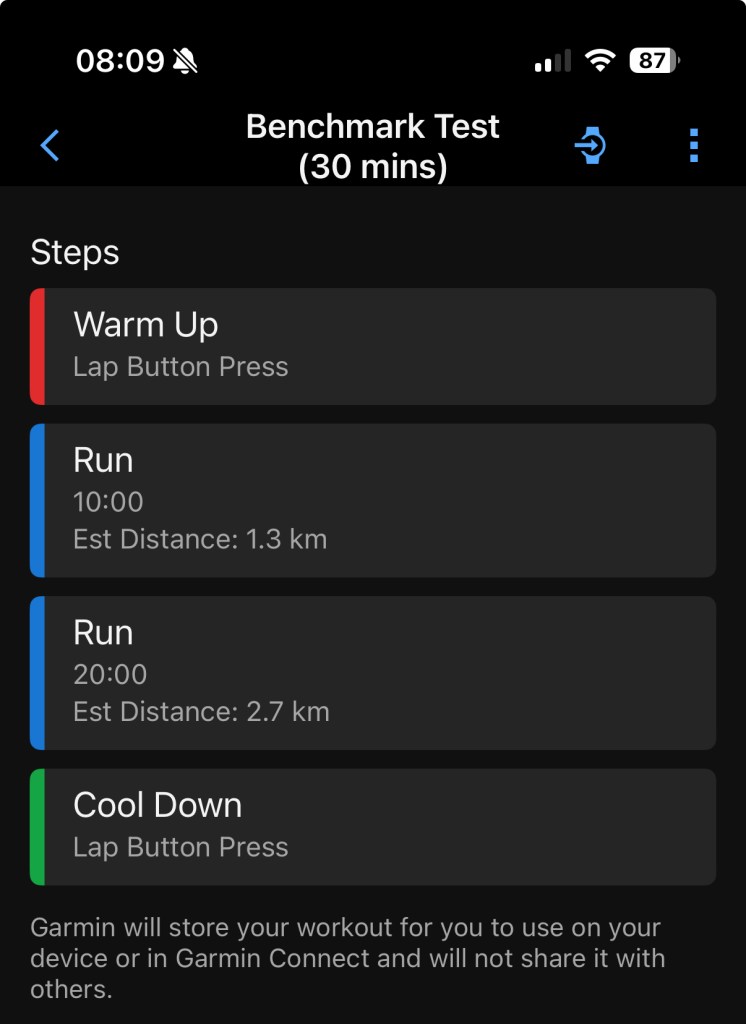
30-Minute Time Trial
Run at the hardest pace you can sustain evenly for 30 minutes. Find your average pace for the last 20 minutes. That’s your LT pace.
Here’s how it looks if you are a Garmin user:
3-Minute All-Out Test
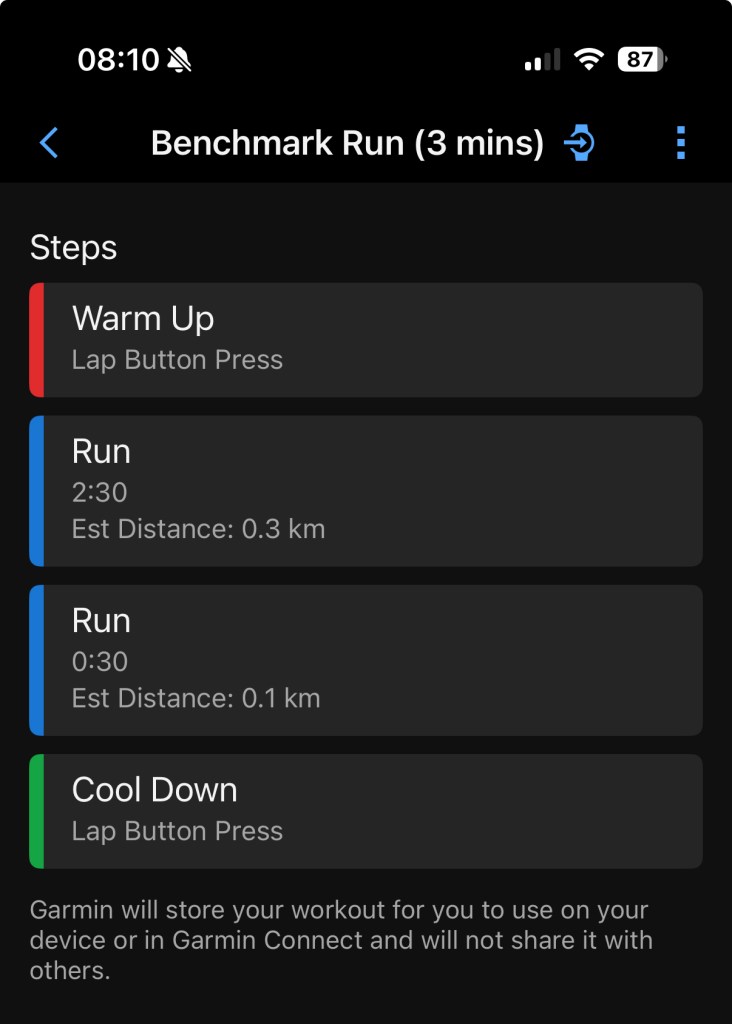
Run as hard as you can for 3 minutes. Your LT pace ≈ the pace you hold in the last 30 seconds.
Example: 135 meters in last 30 seconds = 4:00/km
Here’s how it looks if you are a Garmin user:
Race-Based Estimates
- 10K race: Average pace approximates LT (e.g., 55:00 10K = 5:30/km)
- 5K race: Add 15–30 seconds/km to your race pace (e.g., 30:00 5K = 6:00/km → 6:15–6:30/km LT)
💡 Pro tip: Re-test every 4–6 weeks to update your zones as your fitness improves.
How To Use It
I train mostly by pace and RPE, especially for tempo runs and above. Heart rate is useful, but it tends to lag, drift, or get thrown off by heat, caffeine, or stress. For Zone 2 runs, I use the talk test—if I can speak in full sentences or count to 30 without a deep breath, I’m where I should be.
But for harder efforts—threshold runs, tempo workouts, and long intervals—I lock into LT pace. That’s where the real gains happen.
The longer the race, the longer your tempo duration and interval sets should be. For 5K or 10K training, tempo efforts might last 15–20 minutes; for a half-marathon, 30–45 minutes; for a marathon, longer steady efforts just below threshold or longer LT runs but broken into long blocks (like 2 x 20 mins at LT pace). Interval set distances follow the same principle—shorter reps for 5K (e.g., 1 km), and longer reps for half-marathon to marathon (e.g., 2–4 km). Here’s a general guide with some examples:
- 5K training:
- Tempo runs: 15–20 min continuous at LT
- Intervals: 4 × 1 km @ LT pace, 1 min recovery
- 10K training:
- Tempo runs: 20–30 min continuous
- Intervals: 3 × 3 km @ LT pace, 2-3 min recovery
- Half-marathon training:
- Tempo runs: 30–45 min continuous
- Intervals: 2 × 6 km @ LT pace, 3-4 min recovery
- Marathon training:
- Tempo efforts are often just below LT, but longer—e.g., 60–90 min “steady state” runs at 90–95% of LT pace
- Split LT runs: 2 × 20 min @ LT pace, 5 min recovery
- Long-run finishes: Last 5K at LT pace to simulate race-end fatigue
Don’t extend continuous LT runs beyond 60 minutes, even if you feel strong. Instead, you break the effort into blocks (like 2 × 20 mins) still totaling less than 60 minutes to accumulate more volume without tipping over into unsustainable effort.
Final Thoughts
Whether you’re gunning for a 5K PR or aiming to maintain form through the final 10K of a marathon, knowing your LT pace turns your training from generic to personalized. You’ll train with purpose, recover better, and know exactly when to push and when to hold back.
 Mon Solo's Running Site
One thought on “Benchmark Runs and the Importance of Lactate Threshold”